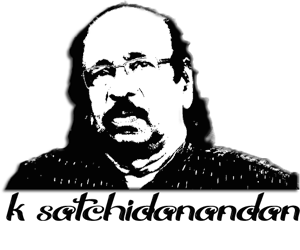
Poems
Those Who Pass
Slowly , slowly they pass by
Those who breastfed and put us to bed
who worked hard to send us
to schools and colleges
those who scolded and punished us
who revered and envied us,
hugged and desired us,
those who longed for our death,
one by one, slowly, slowly.
Slowly ,slowly
A part of us too passes with them,
a small part, a breath, some blood,
a bit of pollen.
All that we climbed up we climb down
All that we climb down we walk
All that walk fall, like leaves,
the greener side down,
clung to earth.
A breeze blows above us
The memories of those who passed
envelope us with the odours of
pepper, garlic, wild jasmine.
Slowly, we come alive, like some statues
coming alive at midnight,
loiter along the ancient times
and recall that old life , line by line,
through measured verses.
The river goes on singing,
the primal song of those who do not die
It cuts across the banks, like time
that has no borders, bodiless,
slowly,
slowly.
One Grief
One grief smells my feet
like a puppy, finds I am not his man
and rushes to my neighbour, wagging his tail.
A bark. A cry.
A joy caresses my cheeks
like a kitten: until another grief
comes crawling by
and winds around to choke me
Then Suddenly
I saw myself among the dead
hiding my face in an umbrella in the rain,
in a black cloak,
like an evening shadow.
I wanted to sing a song, a strange song
about horses, cranes and ships,
just a song that has neither flowers nor birds,
neither sunrises nor love-affairs.
But my lips had been sewn together;
my ears , filled with earth.
Then suddenly the sun rose.
Some Things We Take
Some things we take,
some we give.
Death makes a balance sheet.
Heaven is a lie, but
Hell, yes, it exists.
Just Now
What happens always
is what happens ‘now’.
Time has no door to enter us
except this moment.
Valmiki knew this,
Vyasa and Homer too,
why, even Dante.
But we forget that.
So we think infinity is
somewhere outside us
and eternity is what we confront
only once we die.
We can be indifferent to history,
but do not expect history to spare us.
So let us speak about the rain
pouring down this moment in a torrent
this flower blossoming now
this eye opening in front of us,
and this blood being shed
before our eyes, just now.
Knife
The knife is stuck deep
in the soil, on the green tree,
on a woman’s chest
The one who made it does not see it
His job is done once it has been made.
Learning Languages
I would love to learn languages,
Santali, Balochi, Catalan, Slovenian.
In all these tongues
we can say ‘love’;
we can say ‘kill’ too.
It is too late;
no time even to design a time-piece
may be, I can design a verse-piece
Languages walk past the age of love
bent over a walker.
I too will go,
to the land where I have plenty of time
to learn languages
and then
I will kill you with love.
No Time
There is no more time, but
there are some evil deeds
yet to accomplish.
To divide lovers,
to spread hate and harvest death,
to lead a revolution
that denies happiness
to everyone, equally.
All this calls for hard work.
I have the time for it,
and the impatience too.
Answers
He went on
shouting out the answers.
But the questions,
They went on screaming,
‘O, benevolent one,
please look at us
at least once ’.
To See, To Look
We do not fail to see anything
but we fail to look.
We hear, but do not listen.
The map of an unborn country
painted by a young man’s blood
on the crowded road,
the cry of a woman, as if from a coffin,
drowned in the mob’s tumult,
a piece of adolescent flesh salted with tears
from a boy from Arunachal
in the platter of meat
served in the hotel,
the odour of a mother burning
among the scents from the flowershop,
the manacles of the innocent man,
his eyes closed, seated next to the policeman.
Only when a gentleman with dark glasses
burns our thighs with his cigarette
we stare at him.
Poverty
To see how beautiful poverty is
you need to see the Garo woman
walking along the city street.
The crown of feathers tucked among her hair,
the tattoos that turn her body into a parrot,
the many-coloured bangles that adorn her
from her wrists to the shoulders
like the annual rings of a wild teak ,
the stone necklaces dangling
from her neck up to her waist
reminding you of Goddess Lakshmi
in the calendar-picture.
But in the belly concealed by the loin cloth
in black and red competing for glamour,
only an unquenched fire.
Had You Been A Poet…
(To late Stephen Hawking)
World just passed by
like a cat, its fur rubbing against you.
It did not expect you to discover
a theory of everything anyway.
The dark matter remains dark
even after your entry.
This tiny being on this little planet
knows only one secret:
that secrets are secrets-
not that it is no knowledge.
Galaxies have been made not by laws alone,
but by accidents too,
like our own small lives.
Definitions have little scope, then,
whether of Karma or of Brahma.
Our brain is too small, and universes,
huge, infinite, mysterious: enough for
many generations of philosophers.
Universes would have been, even without us.
They are indifferent to our discoveries.
Had you been a poet, you
would have understood things better:
like Kabir, Allama Prabhu,
or Hafiz.
                                                My moon rises in a valley in Damascus,
                                                shedding light on the Arabian Nights.

                                                My sun sets over the Atlantic,
                                                spreading darkness from Lithuania to Liberia

                                                My stars illumine the Pacific,
                                                Turning each of her islands into gold.

                                                My lexicon comes from all over the world
                                                from Iran and China, Portugal and Rome,
                                                from Netherlands and Arabia
                                                The solid gravity of Sanskrit over
                                                the liquid music of Tamil:
                                                a Himalaya in the Mediterranean.

                                                My bread comes from Vidarbha
                                                where peasants commit suicide;
                                                my water, from Ganga
                                                where orphan corpses bob up and down
                                                The song I sing is of the vanishing Nila river,
                                                the death I die, of the pitch-black Yamuna.

                                                I sleep alone, remembering our Syrian driver
                                                Khalid, of Aleppo. Is he alive still?
                                                At times a homeless Kurd appears in a dream;

                                                at times, a Rohingya refugee raises his roofless head.

                                                I do not know Gikuyu,
                                                I haven’t even been to Palestine.

                                                I set fire to every proof of my having lived;
                                                only one thought remained in that ash
                                                on earth like a flightless bird.
                                                It still lays eggs;
                                                one day, one of them may hatch
                                                a blazing sun that brightens up my village too,
                                                my memories may reappear as its black spots.

                                                Only words fall on my begging bowl:
                                                Kindness. Love. Sacrifice.
                                                Words.
                                                The Black Hole of words.
                                                Birds come after me, as if
                                                I were a walking tree.

                                                I spread my crown for them,
                                                like the mushroom in the Russian children’s tale
                                                growing ever wider to shelter
                                                birds and beasts from rain.

                                                I grow many hands,
                                                from the legs for the parrots,
                                                from the hip for crows,
                                                from the belly and the back
                                                for the cranes, eagles,
                                                kingfishers and  owls
                                                and tiny twigs for
                                                sparrows and treepies.

                                                They fruit, my head opens out
                                                like a tree top , and bats hang from them
                                                undefined, between bird-ness and beastliness.
                                                My hairs blossom, butterflies looking for honey
                                                surround my head like a halo.

                                                As I watch each bird turns into a letter:
                                                an alphabet of birds.

                                                The wind passes between them,
                                                they make many noises,
                                                order themselves into lines,
                                                resound with suggestions,
                                                change places, combine
                                                to become something else,
                                                sing and tell stories.

                                                Vanished hills and forests
                                                crowd their memory,
                                                dried up pools and streams,
                                                roofs and telephone cables
                                                with  screams passing through them
                                                and the scalding grammar
                                                of electric current.

                                                A tree is a dictionary of leaves.
                                                My    branches fill with poems,
                                                the history of clouds*.
                                                *A Histroy of Clouds: the title of a new collection of poems by Hans Magnus Enzensberger
                                                In a flash I recall all the
                                                misplaced objects of my life:
                                                the ten lambent marbles
                                                forgotten under the dry leaves
                                                beneath the mango tree,
                                                the umbrella left behind in Apu's saloon
                                                the day rain failed to turn up,
                                                the pen that dived from the pocket
                                                while climbing the cashewnut tree
                                                on the way back from the village school,
                                                the sky-blue shirt remaining
                                                in a hotel wardrobe in Riga,
                                                the long list of books lent, never returned,
                                                some unredeemed debts, a few unrequited loves.

                                                Forgetfulness alone never forgot me.
                                                As I fell in love I began misplacing my heart,
                                                metaphors as I began to scribble poetry.
                                                Later, looking at the hills, I began to feel
                                                the sky had misplaced them and
                                                the clouds had misplaced the rainbow.

                                                I have recently begun to suspect
                                                this very earth with us on it
                                                has been misplaced by God.
                                                In the order He recalls, He claims back:
                                                woods, rivers, us.
                                                I have never seen you;
                                                may be I never will.
                                                Still I know you are there,
                                                like some unseen stars,
                                                like the first wonder-filled flap
                                                of the just-created bird,
                                                like some half-formed words
                                                on the frontiers of language,
                                                like some planets,
                                                fuming fluid yet.

                                                2
                                                Your crystal-voice
                                                quickens my heartbeat,
                                                like coffee, like pepper,
                                                like jazz, like drugs.

                                                3
                                                You are a dripping tunnel
                                                with light at the end.
                                                I long to get wet
                                                passing through you
                                                listening to the songs
                                                of the forest-birds
                                                that thrill the wind.

                                                4
                                                The scent of how many flowers
                                                from your body shining far-away
                                                Is igniting my senses?

                                                5
                                                Let those hands keep moving,
                                                their bangles laughing,
                                                shaping the fragile idols of love.

                                                6
                                                Who said life is a tree
                                                that blossoms just once
                                                and then dries up?
                                                This is that moment,
                                                unrepeatable, of blossoming.

                                                7
                                                I am a grain of sand
                                                and you, the endless sea.
                                                Let me multiply and be the earth
                                                to contain all of you?

                                                8
                                                I tremble all over like
                                                the tallest building
                                                in a quake-hit city.
                                                You are the oldest of its roads.
                                                Split open so that I may
                                                tumble down to be
                                                devoured by your womb
                                                and open my fresh eyes
                                                into the light of a city
                                                yet to be born.
                                                My granny was insane.
                                                As her madness ripened into death,
                                                my uncle, a miser,
                                                kept her in our storeroom
                                                wrapped in straw.

                                                My granny dried up, burst;
                                                her seeds flew out of the window.
                                                The sun came, and the rain;
                                                one seedling grew up into a tree,
                                                whose lusts bore me.

                                                Can I help writing poems
                                                about monkeys with teeth of gold?
                                                We need rice, salt,
                                                chilly, firewood;
                                                we can do without poetry.
                                                Yet poetry will come back
                                                like rice,
                                                the seed of the earth,
                                                boiled and cleaned of husk and bran,
                                                overflowing every measure
                                                every granary and godown;
                                                like salt,
                                                the memory of the sea,
                                                watering our mouths,
                                                burning us with pain
                                                in order to heal our wounds,
                                                nourishing our roots;
                                                like chilly,
                                                the lust of the clay,
                                                turning hot our lips, tongues,
                                                breasts, waists, veins and nerves;
                                                like the firewood,
                                                the bones of the forest,
                                                their marrow melting sizzling
                                                burning slow with tiny flames,
                                                chanting, in a single breath,
                                                rice salt chilly firewood poetry.
                                                The mad have no caste
                                                or religion. They transcend
                                                gender, live outside
                                                ideologies. We do not deserve
                                                their innocence.

                                                Their language is not of dreams
                                                but of another reality. Their love
                                                is moonlight. It overflows
                                                on the full-moon day.

                                                Looking up they see
                                                gods we have never heard of. They are
                                                shaking their wings when
                                                we fancy they are
                                                shrugging their shoulders. They hold
                                                that even flies have souls
                                                and the green god of grasshoppers
                                                leaps up on thin legs.

                                                At times they see trees bleed, hear
                                                lions roaring from the streets. At times
                                                they watch Heaven gleaming
                                                in a kitten's eyes, just as
                                                we do. But they alone can hear
                                                ants sing in a chorus.

                                                While patting the air
                                                they are taming a cyclone
                                                over the Mediterranean. With
                                                their heavy tread, they stop
                                                a volcano from erupting.

                                                They have another measure
                                                of time. Our century is
                                                their second. Twenty seconds,
                                                and they reach Christ; six more,
                                                they are with the Buddha.

                                                In a single day, they reach
                                                the big bang at the beginning.

                                                They go on walking restless, for
                                                their earth is boiling still.

                                                The mad are not
                                                mad like us.
                                                I see my thirty-year old daughter
                                                again as a six-month old.
                                                I bathe her,wash away
                                                the dust and muck
                                                of thirty years.

                                                Now she glistens like
                                                a short Amichai poem
                                                in the liquid glow of Heaven.
                                                The little towel
                                                gets wet with Time.

                                                Beethoven raises his
                                                more than human hands
                                                turning the window-bars
                                                into piano-keys.

                                                My daughter
                                                emerges out of a symphony
                                                to hug me with
                                                her rose-soft hands.

                                                Outside, rain's bihag :
                                                Kishori Amonkar.
                                                A man walks with a door
                                                along the city street;
                                                he is looking for its house.

                                                He has dreamt
                                                of his woman, children and friends
                                                coming in through the door.
                                                Now he sees a whole world
                                                passing through this door
                                                of his never-built house:
                                                men, vehicles, trees,
                                                beasts, birds, everything.

                                                And the door, its dream
                                                rising above the earth,
                                                longs to be the golden door of heaven,
                                                imagines clouds, rainbows,
                                                demons, fairies and saints
                                                passing through it.

                                                But it is the owner of hell
                                                who awaits the door.
                                                Now it just yearns
                                                to be a tree, full of foliage
                                                swaying in the breeze,
                                                just to provide some shade
                                                to its homeless hauler.

                                                A man walks with a door
                                                along the city street;
                                                a star walks with him.
                                                Every lover is cursed
                                                to forget, at least for a while,
                                                his woman: as the river of
                                                amnesia devours his love.

                                                Every beloved is cursed
                                                to be forgotten until her secret
                                                is trapped in the net of memory.

                                                Every child is cursed
                                                to grow fatherless,
                                                with his hand in the lion's mouth.
                                                Who said
                                                that waiting is a
                                                railway station in North Malabar?
                                                That a dawn in uniform
                                                will arrive there in a coffin?

                                                Who said
                                                that memory is a fragrant window
                                                opening on ripe cornfields?
                                                That our bodies grow cold
                                                as light grows dim there?

                                                Who said
                                                that trees have ceased to follow
                                                wind's language?
                                                That we must conceal
                                                from lilies and rabbits
                                                the news of the death of love?

                                                Who said
                                                that now noons will be
                                                heavy like a drunkard's head?
                                                That evenings will have sick hearts
                                                like a lover's whispered songs?

                                                Who said that we are running barefoot
                                                over red hot iron
                                                with a fistful of childhood rain?
                                                That we will, at the end,
                                                hand over our keys
                                                to the same rain?

                                                Who said that men once dead grow younger
                                                and then they enter another Time?
                                                That all the birds that vanished
                                                at sunrise will return
                                                when the world ends?

                                                Who said
                                                that we would understand everything
                                                with no one saying anything,
                                                but will still not share
                                                anything with anyone?
                                                One day a lean poem
                                                reached Gandhi's ashram
                                                to have a glimpse of the man.
                                                Gandhi spinning away
                                                his thread towards Ram
                                                took no notice of the poem
                                                waiting at his door
                                                ashamed as he was no bhajan.

                                                The poem cleared his throat
                                                and Gandhi looked at him sideways
                                                through those glasses
                                                that had seen Hell.
                                                ‘Have you ever spun thread? ', he asked,
                                                ‘Ever pulled a scavenger's cart?
                                                Ever stood the smoke
                                                of an early morning kitchen?
                                                Have you ever starved? '

                                                The poem said: ‘I was born
                                                in the woods, in a hunter's mouth.
                                                A fisherman brought me up in his hamlet.
                                                Yet, I know no work, I only sing.
                                                First I sang in the courts:
                                                then I was plump and handsome;
                                                but am on the streets now,
                                                half-starved.'

                                                ‘That's better,'Gandhi said
                                                with a sly smile, ‘but you must
                                                give up this habit
                                                of speaking in Sanskrit at times.
                                                Go to the fields,listen to
                                                the peasants' speech.'

                                                The poem turned into a grain
                                                and lay waiting in the fields
                                                for the tiller to come
                                                and upturn the virgin soil
                                                moist with the new rain.
                                                The girl of thirteen
                                                is not the boy of thirteen.
                                                She has died drowning in nightmares
                                                until she forgot her butterflies.
                                                She has passed through caverns of darkness
                                                leaving the lullabies behind.

                                                The girl of thirteen is forty-three.
                                                She knows a bad touch from a good one
                                                She knows it’s not wrong
                                                to tell a lie in order to survive.
                                                She knows how to fight a war,
                                                with teeth or with songs.
                                                You see only the rose on her body;
                                                but it’s full of thorns

                                                The girl of thirteen can fly.
                                                She doesn’t want to leave the sun
                                                and books just for men.
                                                Her swing circles the moon
                                                and moves from melancholy to madness.
                                                She doesn’t dream of the prince
                                                as you seem to think.

                                                The girl of thirteen has her feet
                                                in the netherworld even as she
                                                touches the rainbow.
                                                One day, sword in her hand, she
                                                will come riding a white horse.
                                                Listening to the hooves echo in the clouds
                                                you will know , the tenth avatar
Alone I sit in this valley of crickets
in the fog spreading like frozen moonlight.
This house-gecko does not understand Malayalam,
so I speak to my glass that knows many languages.
It winks at me and tells me: ‘Your time is not far’
I feel like flinging it down and scream, ‘Yours too’,
But I restrain myself. Instead like a beloved
I raise it to my lips, and intoxicated,
forget I am alone.
‘Anand re…†Ulhas Kashalkar sings an abhang
in Bhairavi. Accompanied by the orchestra
of the future, assuring me that death happens
only in the present.
Pushing open the door I had locked from inside,
you and wind and rain rush in. You sit on my lap,
I play you like a veena in yaman kalyan.
Lightning or death can no more frighten me.
I will rise again and again in your love,
like the morning sun that reddens
that nameless flower below.
Marlon James’s novel on my settee
opens by itself and the slain Bob Marley
descends its pages and sings: ‘ Rise up!
Stand up! Stand up for your rights!’
‘Is it the right to love?’, you ask. ‘Yes,
That too is a right. And to sing. And dream.
Dreams have no constitution.’
I want to live. Until the earth is covered
with green feathers. Until that parrot sings
this time about Ravan who was ready to
die for his love.
                                                Not only the oceans,
                                                mountains too have their secrets.

                                                You will say the laughter
                                                you hear from afar
                                                is the sound  of waterfalls.
                                                No, it is seven fairies laughing.

                                                These little crisscrossing pebbly
                                                paths are ways that lead you
                                                to different worlds.  You may reach
                                                the netherworld or the world of the dead.

                                                Those wild paths that go up may
                                                lead you to the Moon or Mars or Heaven.

                                                Don’t mount those horses:
                                                The black ones will take you to the Middle Ages
                                                and the white ones to  solitude.

                                                Did you see that blue bird?
                                                It was a violinist in its last birth
                                                and that brown bird was a drummer-
                                                just as this white stone here
                                                was a star.

                                                The people here
                                                call salvation water.

                                                It is at night that nothingness,
                                                beasts and ghosts  come out.
                                                The ghosts are mostly
                                                of the White who once ruled here.
                                                Don’t be scared, they are no more;
                                                only their guns live on.

                                                Go through that tunnel,
                                                and you will reach Hell.
                                                That is where the subjects live.
                                                They have been weaving
                                                a blanket for centuries.
                                                When it is done, this place
                                                will come to an end.

                                                This posture of the earth,
                                                lying on her back,
                                                eyes closed , knees in the air,
                                                is an invitation.
                                                You cannot refuse it
                                                nor accept it.

                                                None who came here has gone back;
                                                and, as for her,
                                                she  never  parts her legs.
                                                Some kinds of love are like flu.
                                                First you sneeze, your body aches all over
                                                you are hot outside and inside.
                                                It subsides after a week of nightmares;
                                                now you are in forgetful repose.

                                                Some kinds of love are like smallpox.
                                                You wonder whether
                                                what you see on  your skin
                                                are blisters or gooseflesh.
                                                Your body is red-hot with love
                                                You may survive it, but
                                                the pockmarks remain.
                                                You carry those scarred memories
                                                on your body until you die.

                                                Some kinds of love are like cancer.
                                                You take time to diagnose  it.
                                                The pain starts too late.
                                                By the time she is already
                                                someone else’s.
                                                The drugs to stop that love-cell
                                                from multiplying in vain
                                                will turn you thin and pale
                                                like the proverbial lover.
                                                When indifference fails,
                                                a knife alone can save you.
                                                Maimed thus, you live like dead.
                                                When it spreads again
                                                death kindly tempts you from
                                                the branch of a tree, a river,
                                                a tall balcony or a small bottle.
                                                Love survives you.

                                                Some kinds of love are like madness.
                                                You are lost entirely
                                                in a world of imagination;
                                                your beloved does not even
                                                know of your love. .
                                                You murmur, sing, laugh, quarrel
                                                and roam around, all, alone.
                                                Neither shackles nor electric shocks
                                                can tame it, for, it is no disease,
                                                but is a state of dream;
                                                hence it lives among the stars.

                                                The sweetest love is
                                                the unrealised one,
                                                like Radha’s.
                                                Don’t look for the way
                                                to heaven in holy books.
                                                Ask instead the extinct plants
                                                and beasts.

                                                Orphans know it;
                                                some sparrows too.
                                                The blind know it;
                                                some sorrows too.

                                                It is not those in golden crowns
                                                that attain heaven,  but
                                                the mad women with their
                                                tiaras of leaves and rags.
                                                Then too the ripe jack fruit leaves
                                                drunk with the evening breeze
                                                playing their copper  lyre
                                                as they float and fly,
                                                herds of clouds who have
                                                lost their shepherds,
                                                and dust soaring up from waste-heaps
                                                with dreams of gold.

                                                There is a coral tree on
                                                each step to heaven;
                                                with their thorns
                                                they put to trial every century of man,
                                                ask for the numbers of the
                                                slain and the maimed.

                                                We will have to leave back
                                                all the  beliefs we had held dear;
                                                our answers are denied entry.
                                                On the way to heaven are
                                                the dense forests of the questions
                                                we failed to ask on earth,
                                                the rushing cataracts of
                                                instincts we ruthlessly suppressed,
                                                our silent selves that we had
                                                abandoned on the wayside
                                                to please someone.

                                                Since there is no Time here
                                                our hair does not turn grey in its slow fire,
                                                years do not leave their
                                                plough-marks on our face
                                                knowledge does not weigh us down.
                                                No desire that hurts, no hope that scalds .

                                                There are no doors that are only half-open,
                                                no complaining graveyards,
                                                no souls screaming for a body to be reborn.

                                                Here we take our baby steps against
                                                the dance of death, we boldly sing
                                                the songs we were scared to sing.

                                                Heaven
                                                is nothing but
                                                the life we never lived,
                                                and are still scared of  living.